Summary: In this non-fiction text, Albee uncovers the history of poop and all things related to it. The book covers topics beginning with the invention of the toilet. Other topics include: how knights in shiny armor poop, how moats were used for waste disposal, when urine was tested to check for diseases, Europeans bathing in the 17th century, hygiene, and euphemisms for the toilet. The book ends with a page full of reflection and leaves the reader with room to ponder about the future of sewage systems.
Bib Info:
Albee, S. (2010). Poop happened! New York, NY: Walker Publishing Company.
Interest Level: 3-6
Impression: This book is humorous and informative as it covers a topic that is often not up for discussion. It covers topics that students may wonder about, but might not ask. The lay-out makes it easy to skim through and has fun illustrations.
Reviews and Awards:
Booklist 02/15/10, Publishers Weekly 05/03/10, Bulletin of the Center for Children's Books 08/01/10, School Library Journal 05/01/10, Horn Book 10/01/10, Voice of Youth Advocates (VOYA) 02/01/10, Kirkus Reviews 04/15/10, Wilson's Children 10/01/10, Library Media Connection 08/01/10, Wilson's Junior High School 10/01/10
Reviews:
If you like potty talk and humor, this could be the book for you. Done with flare and intrigue, the book covers how body waste was treated throughout history from prehistoric times to current day. Chapters cover Ancient Egypt, Greece, Rome, the Renaissance, France, England, and America leading to outer space. Not only are human wastes highlighted, but also animals that play a role in the diseases that affected our history. Well written with lots of interesting facts throughout, the book connects the reader with the importance of the subject. Students will love finding out that there is a Roman goddess of sewers, fossilized dinosaur feces have been unearthed, and castle moats contained only sewage. Author Sarah Albee gives the reader small chunks of information at a time, broken up with amazing anecdotes such as Icky Occupations and Hygiene Heroes. Students will want to check this book out just by the title alone, but they will need a strong stomach to enjoy it cover to cover. Many students will love the gross-out factor. Go grab a clothespin for your nose and dive into this extraordinary book. Recommended.
Mooney, M. (2010, August/September). [Review of the book Poop Happened!, by S. Albee]. Library Media Connection. Retrieved from: http://www.librarymediaconnection.com/
Gr 4-8-This self-proclaimed "number one book on number two" takes readers inside the fascinating world of excrement, ranging across the historical spectrum from "Hellenic Hygiene" to "How Do Astronauts Use the Toilet in Space?" Albee's focus is not only on bodily functions, but also on the larger public-health challenges created by mass urbanization in the ancient and modern world as well as the ability of societies to deal with these problems, which provides readers with an excellent introduction to social history. With a focus on the Western world in general and England in particular, the author touches on an array of topics from diseases such as cholera and plague to the development of increased sanitation in large urban areas such as London. The exciting format is comprised of a two-color (pastel green and blue) layout with numerous illustrations and photos. Interesting sidebars describe occupations and "hygiene heroes" such as Edwin Chadwick and bathroom fashion. The fluid writing style that ensnares and holds readers' attention from beginning to end. By bringing history alive, this captivating work is without a doubt an essential purchase.
Odom, B. (2010, May 1). [Review of the book Poop Happened!, by S. Albee]. School Library Journal. Retrieved from: http://www.slj.com/
Use in library setting:
This book would be a fun way to reel students into showing an interest in an informational text. This book can be used as springboard to teach students that an informational book does not have to be read from cover to cover. The layout of this particular book includes many headings which is perfect for picking and choosing what to read and what to skip over or save for later.
Thursday, August 9, 2012
Owen & Mzee The Language of Friendship
Summary: Owen & Mzee The Language of Friendship is story shows a bond that was developed between a tortoise and a hippopotamus. This information text tells the story of how the two animals met and illustrates their friendship with real photographs accompanied by captions.
Bib Info: Hatkoff, C., Hatkoff, I., & Kahumbu, P. (2007). Owen & Mzee the language of friendship. New York, NY: Scholastic Press.
Interest Level: 3-6
Impression: I really enjoyed how it tells a story of a friendship mixed with facts. The book contains authority based on one of the authors being the director of the Haller Park Sanctuary where Owen and Mzee live. I found it neat that Owen & Mzee have a website.
Reviews and Awards: Book Links 07/01/07, Kirkus Reviews 12/15/06, Booklist starred 12/15/06, Publishers Weekly starred 11/13/06, Bulletin of the Center for Children's Books 02/01/07, School Library Journal starred 02/01/07, Horn Book 10/01/07, Wilson's Children 10/01/10
Reviews: In their second book about the young hippo and elderly tortoise living in a Kenyan wildlife sanctuary, the authors report on the pair's first year and a half together. The color photos are topflight, and the anecdotes (such as one about new tortoise pal Toto) will satisfy fans of the odd couple. Thankfully, this book tones down the first book's sentimentality and anthropomorphism.
[Review of the book Owen & Mzee the language of friendship, by C. Hatkoff, I. Hatkoff, & P. Kahumbu ]. (2007, Fall). Horn Book. Retrieved from: http://www.hbook.com/
K-Gr 4-Owen & Mzee: The True Story of a Remarkable Friendship (Scholastic, 2006) chronicled the fascinating story of a baby hippo who was orphaned by the December 2004 tsunami and the bond he formed with Mzee, a 130-year-old Alhambra tortoise at a wildlife sanctuary in Kenya. This sequel updates readers on the status of that friendship a year and a half later, particularly with regard to the way this unusual duo has learned to communicate with one another. They apparently call back and forth, making sounds that hippos and tortoises do not usually make. The authors honestly discuss the issues that will face these two friends in the future, as their caretakers become increasingly concerned that Owen could become a danger to Mzee as he continues to grow. Other problems and possible solutions are discussed. The text is clearly written and accompanied by numerous high-quality, full-color photos of this unique pair. Children captivated by the first book will be thrilled to discover this one, and enough background information is provided so that readers coming to the story for the first time will be comfortable. A first purchase for most libraries.-Grace Oliff, Ann Blanche Smith School, Hillsdale, NJ Copyright 2007 Reed Business Information.
Oliff, G. (2007, February 1). [Review of the book Owen & Mzee the language of friendship, by C. Hatkoff, I. Hatkoff, & P. Kahumbu]. School Library Journal. Retrieved from: http://www.slj.com/
Use in library setting: This book can be used in conjunction with researching about a tortoise and hippopotamus. This can be linked to further discussion about the unlikely friendship of the two animals.
Bib Info: Hatkoff, C., Hatkoff, I., & Kahumbu, P. (2007). Owen & Mzee the language of friendship. New York, NY: Scholastic Press.
Interest Level: 3-6
Impression: I really enjoyed how it tells a story of a friendship mixed with facts. The book contains authority based on one of the authors being the director of the Haller Park Sanctuary where Owen and Mzee live. I found it neat that Owen & Mzee have a website.
Reviews and Awards: Book Links 07/01/07, Kirkus Reviews 12/15/06, Booklist starred 12/15/06, Publishers Weekly starred 11/13/06, Bulletin of the Center for Children's Books 02/01/07, School Library Journal starred 02/01/07, Horn Book 10/01/07, Wilson's Children 10/01/10
Reviews: In their second book about the young hippo and elderly tortoise living in a Kenyan wildlife sanctuary, the authors report on the pair's first year and a half together. The color photos are topflight, and the anecdotes (such as one about new tortoise pal Toto) will satisfy fans of the odd couple. Thankfully, this book tones down the first book's sentimentality and anthropomorphism.
[Review of the book Owen & Mzee the language of friendship, by C. Hatkoff, I. Hatkoff, & P. Kahumbu ]. (2007, Fall). Horn Book. Retrieved from: http://www.hbook.com/
K-Gr 4-Owen & Mzee: The True Story of a Remarkable Friendship (Scholastic, 2006) chronicled the fascinating story of a baby hippo who was orphaned by the December 2004 tsunami and the bond he formed with Mzee, a 130-year-old Alhambra tortoise at a wildlife sanctuary in Kenya. This sequel updates readers on the status of that friendship a year and a half later, particularly with regard to the way this unusual duo has learned to communicate with one another. They apparently call back and forth, making sounds that hippos and tortoises do not usually make. The authors honestly discuss the issues that will face these two friends in the future, as their caretakers become increasingly concerned that Owen could become a danger to Mzee as he continues to grow. Other problems and possible solutions are discussed. The text is clearly written and accompanied by numerous high-quality, full-color photos of this unique pair. Children captivated by the first book will be thrilled to discover this one, and enough background information is provided so that readers coming to the story for the first time will be comfortable. A first purchase for most libraries.-Grace Oliff, Ann Blanche Smith School, Hillsdale, NJ Copyright 2007 Reed Business Information.
Oliff, G. (2007, February 1). [Review of the book Owen & Mzee the language of friendship, by C. Hatkoff, I. Hatkoff, & P. Kahumbu]. School Library Journal. Retrieved from: http://www.slj.com/
Use in library setting: This book can be used in conjunction with researching about a tortoise and hippopotamus. This can be linked to further discussion about the unlikely friendship of the two animals.
Tomas and the Library Lady
Summary: Tomas travels from Texas to Iowa with his parents, who are farm workers. He expresses his interest in stories that his grandfather tells. His grandfather shares that Tomas is old enough to read and tells him that there are books in the library. This was a scary adventure for Tomas to take. The librarian in Iowa makes him feel welcome and helps him find books of interest, which forms a bond between the librarian and the new lifelong reader.
Bib Info: Mora, P. (1997). Tomas and the library lady. New York, NY: Random House.
Interest Level:K-3
Impression: This story shares how Tomas was encouraged by a librarian to read. I like that it explores the escape that can take place when one reads a book. This book includes culture, as well, and exposes its readers to some Spanish.
Reviews and Awards: Book Links 01/01/09, L.A. Recommended Foreign Language 02/01/99, Booklist 08/01/97, Publishers Weekly 07/21/97, Bulletin of the Center for Children's Books 10/01/97, School Library Journal 10/01/97, Elementary School Library Collection 06/01/00, Wilson's Children 10/01/10, Kirkus Reviews 08/01/97
Reviews: In a story inspired by the life of Tomás Rivera, a migrant worker who became a nationally known educator, young Tomás and his family, migrant farm workers, leave Texas for work in Iowa, where Tomás discovers the wonder of books at the local library. Colón's scratchboard illustrations convey the magic of reading and of telling stories, but give little sense of the time period or poverty of Tomás's life. [Review of the book Tomas and the library lady, by P. Mora]. (1998, March). Horn Book. Retrieved from: http://www.hbook.com/
A charming, true story about the encounter between the boy who would become chancellor at the University of California at Riverside and a librarian in Iowa. Tomás Rivera, child of migrant laborers, picks crops in Iowa in the summer and Texas in the winter, traveling from place to place in a worn old car. When he is not helping in the fields, Tomás likes to hear Papa Grande's stories, which he knows by heart. Papa Grande sends him to the library downtown for new stories, but Tomás finds the building intimidating. The librarian welcomes him, inviting him in for a cool drink of water and a book. Tomás reads until the library closes, and leaves with books checked out on the librarian's own card. For the rest of the summer, he shares books and stories with his family, and teaches the librarian some Spanish. At the end of the season, there are big hugs and a girl exchange: sweet bread from Tomás's mother and a shiny new book from the librarian--to keep. Coldón's dreamy illustrations capture the brief friendship and its life-altering effects in soft earth tones, using round sculptured shapes that often depict the boy right in the middle of whatever story realm he's entered. [Review of the book Tomas and the library lady, by P. Mora]. (1997). Kirkus Reviews. Retrieved from: http://www.kirkusreviews.com/
Use in library setting: This multicultural book can be used to introduce storytelling to students.
Bib Info: Mora, P. (1997). Tomas and the library lady. New York, NY: Random House.
Interest Level:K-3
Impression: This story shares how Tomas was encouraged by a librarian to read. I like that it explores the escape that can take place when one reads a book. This book includes culture, as well, and exposes its readers to some Spanish.
Reviews and Awards: Book Links 01/01/09, L.A. Recommended Foreign Language 02/01/99, Booklist 08/01/97, Publishers Weekly 07/21/97, Bulletin of the Center for Children's Books 10/01/97, School Library Journal 10/01/97, Elementary School Library Collection 06/01/00, Wilson's Children 10/01/10, Kirkus Reviews 08/01/97
Reviews: In a story inspired by the life of Tomás Rivera, a migrant worker who became a nationally known educator, young Tomás and his family, migrant farm workers, leave Texas for work in Iowa, where Tomás discovers the wonder of books at the local library. Colón's scratchboard illustrations convey the magic of reading and of telling stories, but give little sense of the time period or poverty of Tomás's life. [Review of the book Tomas and the library lady, by P. Mora]. (1998, March). Horn Book. Retrieved from: http://www.hbook.com/
A charming, true story about the encounter between the boy who would become chancellor at the University of California at Riverside and a librarian in Iowa. Tomás Rivera, child of migrant laborers, picks crops in Iowa in the summer and Texas in the winter, traveling from place to place in a worn old car. When he is not helping in the fields, Tomás likes to hear Papa Grande's stories, which he knows by heart. Papa Grande sends him to the library downtown for new stories, but Tomás finds the building intimidating. The librarian welcomes him, inviting him in for a cool drink of water and a book. Tomás reads until the library closes, and leaves with books checked out on the librarian's own card. For the rest of the summer, he shares books and stories with his family, and teaches the librarian some Spanish. At the end of the season, there are big hugs and a girl exchange: sweet bread from Tomás's mother and a shiny new book from the librarian--to keep. Coldón's dreamy illustrations capture the brief friendship and its life-altering effects in soft earth tones, using round sculptured shapes that often depict the boy right in the middle of whatever story realm he's entered. [Review of the book Tomas and the library lady, by P. Mora]. (1997). Kirkus Reviews. Retrieved from: http://www.kirkusreviews.com/
Use in library setting: This multicultural book can be used to introduce storytelling to students.
Goin' Someplace Special
Summary: Tricia Ann is on her way to a special place. Her character must remain brave along the way of her journey as she is continuously made aware of the segregation around her. In the end she makes it to her special place, which is a library. It is revealed that this place is special to her because everyone is welcome.
Bib Info: McKissack, P.C. (2001). Goin’ Someplace Special. New York, NY: Antheneum Books for Young Readers.
Interest Level: K-3
Impression: Tricia Ann’s character in the story reveals many emotions as she makes her way to the public library. At one point, she wanted to give up and head back home. Instead, she remained strong and determined to get to the library where she knew it was one place where she didn’t have to worry about segregation.
Reviews and Awards: ALA Notable Children's Books 2002, Kirkus Reviews 09/15/01, Book Links 01/01/07, New York Times 02/10/02, Booklist starred 08/01/01, Publishers Weekly 08/06/01, Bulletin of the Center for Children's Books 09/01/01, School Library Journal 09/01/01, Coretta Scott King Illustrator Award 2002, Wilson's Children 10/01/10, Horn Book 11/01/01
Reviews: Gr 3-5-'Tricia Ann's first solo trip out of her neighborhood reveals the segregation of 1950s' Nashville and the pride a young African-American girl takes in her heritage and her sense of self-worth. In an eye-opening journey, McKissack takes the child through an experience based upon her own personal history and the multiple indignities of the period. She experiences a city bus ride and segregated parks, restaurants, hotels, and theaters and travels toward "Someplace Special." In the end, readers see that 'Tricia Ann's destination is the integrated public library, a haven for all in a historical era of courage and change. Dialogue illustrates her confidence and intelligence as she bravely searches for truth in a city of Jim Crow signs. Pinkney re-creates the city in detailed pencil-and-watercolor art angled over full-page spreads, highlighting the young girl with vibrant color in each illustration. A thought-provoking story for group sharing and independent readers.
Elam, M. (2001, September 1). [Review of the book Goin’ someplace special by P. McKissack]. School Library Journal. Retrieved from: http://www.slj.com/
Pinkney's characteristic, pastel watercolors place this story long ago. 'Tricia Ann is excited about the prospect of going someplace special without her grandmother, until she loses her way in a throng of folks who push her into a hotel lobby where "colored people" aren't allowed. References to seats at the back of the bus and a "Jim Crow sign" indicating the "colored section," as well as a bench labeled "for whites only," will require explanation for children. The special place named in the title is the public library, where "all are welcome." (The drawings of stone blocks and columns on the endpapers suggest Andrew Carnegie's libraries.) McKissack concludes her story with information about her childhood in Nashville, Tennessee, and the importance of the love, respect, and pride that fortified her and enabled her, as they do 'Tricia Ann, to face racial bigotry and discrimination. This book would be useful for discussions of daily life and instances of injustice in the 1950s, civil rights, and the importance of free access to information and recreational reading. As such, it would be a wonderful addition to library and school collections. Recommended.
Nelson, A.B. (2002, March/April). [Review of the book Goin’ someplace special by P. McKissack]. Library Talk. Retrieved from: http://www.librarymediaconnection.com/lmc/
Use in library setting: This book could be used during a storytime to explore segregation and feelings. The students can then compare and contrast how things are today versus how they were when Tricia Ann was going to the library.
Bib Info: McKissack, P.C. (2001). Goin’ Someplace Special. New York, NY: Antheneum Books for Young Readers.
Interest Level: K-3
Impression: Tricia Ann’s character in the story reveals many emotions as she makes her way to the public library. At one point, she wanted to give up and head back home. Instead, she remained strong and determined to get to the library where she knew it was one place where she didn’t have to worry about segregation.
Reviews and Awards: ALA Notable Children's Books 2002, Kirkus Reviews 09/15/01, Book Links 01/01/07, New York Times 02/10/02, Booklist starred 08/01/01, Publishers Weekly 08/06/01, Bulletin of the Center for Children's Books 09/01/01, School Library Journal 09/01/01, Coretta Scott King Illustrator Award 2002, Wilson's Children 10/01/10, Horn Book 11/01/01
Reviews: Gr 3-5-'Tricia Ann's first solo trip out of her neighborhood reveals the segregation of 1950s' Nashville and the pride a young African-American girl takes in her heritage and her sense of self-worth. In an eye-opening journey, McKissack takes the child through an experience based upon her own personal history and the multiple indignities of the period. She experiences a city bus ride and segregated parks, restaurants, hotels, and theaters and travels toward "Someplace Special." In the end, readers see that 'Tricia Ann's destination is the integrated public library, a haven for all in a historical era of courage and change. Dialogue illustrates her confidence and intelligence as she bravely searches for truth in a city of Jim Crow signs. Pinkney re-creates the city in detailed pencil-and-watercolor art angled over full-page spreads, highlighting the young girl with vibrant color in each illustration. A thought-provoking story for group sharing and independent readers.
Elam, M. (2001, September 1). [Review of the book Goin’ someplace special by P. McKissack]. School Library Journal. Retrieved from: http://www.slj.com/
Pinkney's characteristic, pastel watercolors place this story long ago. 'Tricia Ann is excited about the prospect of going someplace special without her grandmother, until she loses her way in a throng of folks who push her into a hotel lobby where "colored people" aren't allowed. References to seats at the back of the bus and a "Jim Crow sign" indicating the "colored section," as well as a bench labeled "for whites only," will require explanation for children. The special place named in the title is the public library, where "all are welcome." (The drawings of stone blocks and columns on the endpapers suggest Andrew Carnegie's libraries.) McKissack concludes her story with information about her childhood in Nashville, Tennessee, and the importance of the love, respect, and pride that fortified her and enabled her, as they do 'Tricia Ann, to face racial bigotry and discrimination. This book would be useful for discussions of daily life and instances of injustice in the 1950s, civil rights, and the importance of free access to information and recreational reading. As such, it would be a wonderful addition to library and school collections. Recommended.
Nelson, A.B. (2002, March/April). [Review of the book Goin’ someplace special by P. McKissack]. Library Talk. Retrieved from: http://www.librarymediaconnection.com/lmc/
Use in library setting: This book could be used during a storytime to explore segregation and feelings. The students can then compare and contrast how things are today versus how they were when Tricia Ann was going to the library.
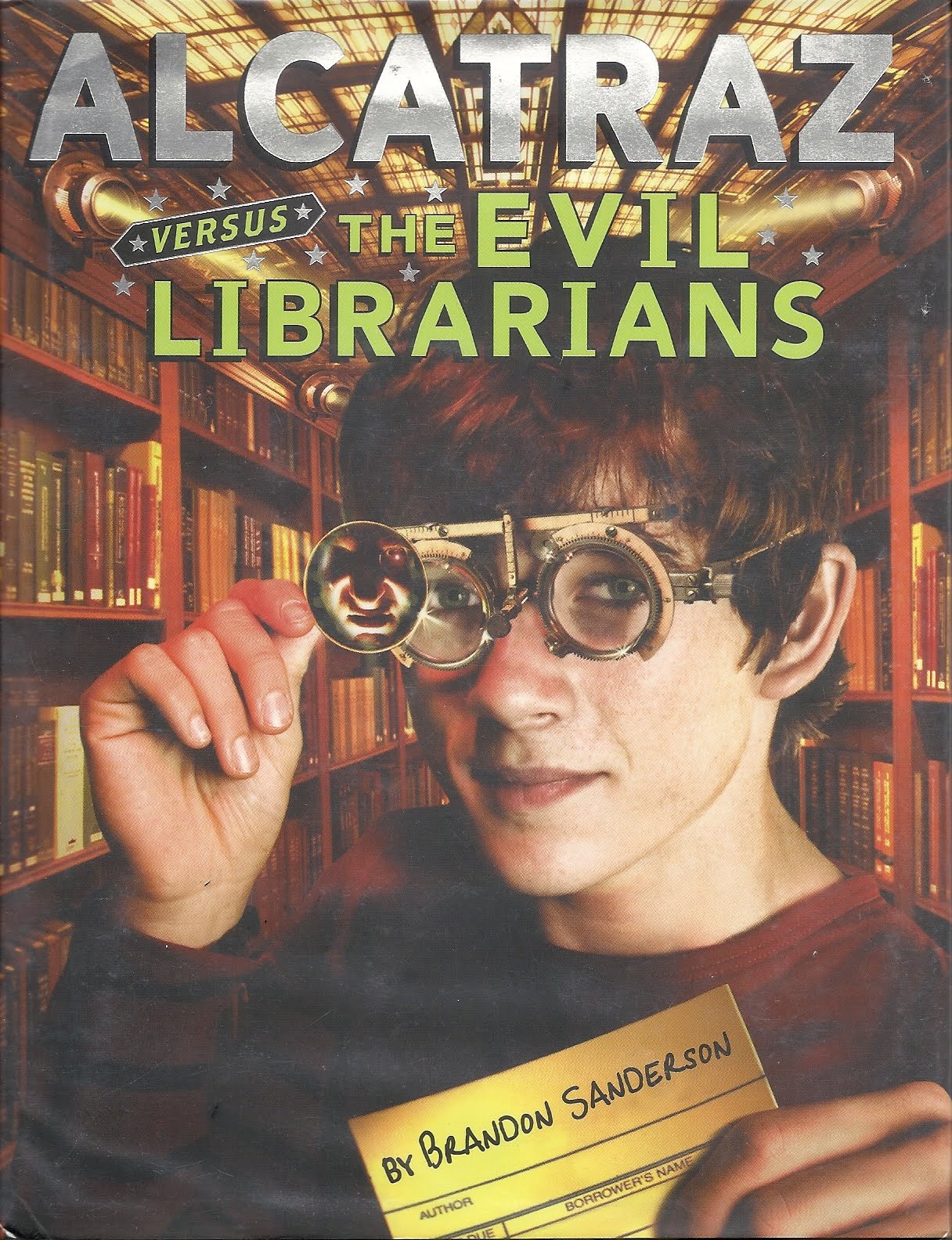
Alcatraz Versus the Evil Librarians
Summary: This story is about a boy named Alcatraz Smedry who was abandoned by his parents. He has been bouncing around from foster home to foster home. Approaching age 13, the evil librarians are keeping a close eye on him. He receives a gift of sand from his father for his birthday, which quickly makes the action in this story come to life. On his journey with Grandfather Smedry, he discovers that his ability to break things is considered a talent. He learns that he is an Oculator and that the evil librarians who want to be the reins on all information, including the sand. In the end, Alcatraz learns that his father is an Oculator and his mother is one of them…an evil librarian.
Bib Info: Sanderson, Brandon. (2007). Alcatraz versus the evil librarians. New York, NY: Scholastic Press.
Interest Level: 3-6
Impression: Alcatraz Smedry is a humorous character who has good intentions in everything he does. He possesses the ability to break things and doesn’t intentionally mean to. As an orphan, he wonders where his real parents are and struggles staying in one foster home for long. He spends the book talking to the reader and uses sarcasm throughout. It is an entertaining fantasy read.
Reviews and Awards: Bulletin of the Center for Children's Books 02/01/08, School Library Journal 11/01/07, Horn Book 01/01/08, Voice of Youth Advocates (VOYA) 10/01/07, Horn Book starred 04/01/08, Wilson's Children 10/01/10, Publishers Weekly starred 11/19/07, Wilson's Junior High School 01/09/10
Reviews: In Sanderson's (Elantris) children's debut, an over-the-top fantasy/adventure, librarians are evil because they control all the information in Hushland (America). They distort some facts and fabricate the rest. Alcatraz, meanwhile, is the name of the protagonist, who has been raised in a series of foster homes. As the novel opens, on his 13th birthday, he is quickly initiated into the true nature of librarians by his heretofore unmet grandfather, Leavenworth Smedry. Before long, Sanderson brings on talking dinosaurs (it's a librarian distortion that they're extinct), a parallel world, visiting villains and more. The madcap plot can seem chaotic, with action pulling Alcatraz toward new characters at a breakneck speed, but Sanderson unexpectedly draws everything together in an extravagantly silly climax. Readers whose sense of humor runs toward the subversive will be instantly captivated: not only does the author poke fun at librarians, he lampoons books (including this one) in frequent passages directly addressed to readers: "You are saying to yourself, 'The story just lost me. It degenerated into pure silliness.... I'm going to go read a book about a boy whose dog gets killed by his mother. Twice.'" Like Lemony Snicket and superhero comics rolled into one (and then revved up on steroids), this nutty novel isn't for everyone, but it's also sure to win passionate fans. Ages 9-up.
[Review of the book Alcatraz versus the evil librarians by B. Sanderson]. (2007, November 17). Publishers Weekly. Retrieved from: http://www.publishersweekly.com/pw/home/index.html
Gr 5-8-The conventional trappings of the middle-school fantasy get turned upside down in this zany novel. Alcatraz is a 13-year-old boy with hidden powers, but his talent is "breaking things." The powerful object he must find is a bag of sand, he battles monsters made of paper, and his arch nemeses are evil librarians. It all sounds ludicrous, but there is actually some consistent logic that makes the adventures engaging, as well as silly. Seemingly random insertions, such as a bunch of very civilized dinosaurs that speak with English accents, later play key roles in the plot development. Alcatraz opens nearly every chapter by addressing readers directly, and frequently interrupts the narrative, a technique that adds to the enjoyable bizarreness. He reflects flippantly upon writing techniques, gives broad hints about what may happen next, and even tells outright lies about his own story. It takes a while to adjust to this intentionally chaotic narration, but it ultimately becomes quite effective. The details of this fantasy world, where librarians dominate "Hushlanders" by withholding information about many things, including the existence of three other continents, make just enough sense to frame the sometimes frantic plot. Though there's intentionally more humor than drama, Alcatraz becomes a more complex figure by the time his adventure is through as he discovers the value of friendship, courage, and family. Readers who prefer fantasy with plenty of humor should enjoy entering Alcatraz's strange but amusing world.
Engelfried, S. (2007, November 1). [Review of the book Alcatraz versus the evil librarians by B. Sanderson]. School Library Journal. Retrieved from: http://www.slj.com/
Use in library setting: This book can be used to teach point-of-view in writing. It can also be used to have students act out their favorite parts of the story.
Bib Info: Sanderson, Brandon. (2007). Alcatraz versus the evil librarians. New York, NY: Scholastic Press.
Interest Level: 3-6
Impression: Alcatraz Smedry is a humorous character who has good intentions in everything he does. He possesses the ability to break things and doesn’t intentionally mean to. As an orphan, he wonders where his real parents are and struggles staying in one foster home for long. He spends the book talking to the reader and uses sarcasm throughout. It is an entertaining fantasy read.
Reviews and Awards: Bulletin of the Center for Children's Books 02/01/08, School Library Journal 11/01/07, Horn Book 01/01/08, Voice of Youth Advocates (VOYA) 10/01/07, Horn Book starred 04/01/08, Wilson's Children 10/01/10, Publishers Weekly starred 11/19/07, Wilson's Junior High School 01/09/10
Reviews: In Sanderson's (Elantris) children's debut, an over-the-top fantasy/adventure, librarians are evil because they control all the information in Hushland (America). They distort some facts and fabricate the rest. Alcatraz, meanwhile, is the name of the protagonist, who has been raised in a series of foster homes. As the novel opens, on his 13th birthday, he is quickly initiated into the true nature of librarians by his heretofore unmet grandfather, Leavenworth Smedry. Before long, Sanderson brings on talking dinosaurs (it's a librarian distortion that they're extinct), a parallel world, visiting villains and more. The madcap plot can seem chaotic, with action pulling Alcatraz toward new characters at a breakneck speed, but Sanderson unexpectedly draws everything together in an extravagantly silly climax. Readers whose sense of humor runs toward the subversive will be instantly captivated: not only does the author poke fun at librarians, he lampoons books (including this one) in frequent passages directly addressed to readers: "You are saying to yourself, 'The story just lost me. It degenerated into pure silliness.... I'm going to go read a book about a boy whose dog gets killed by his mother. Twice.'" Like Lemony Snicket and superhero comics rolled into one (and then revved up on steroids), this nutty novel isn't for everyone, but it's also sure to win passionate fans. Ages 9-up.
[Review of the book Alcatraz versus the evil librarians by B. Sanderson]. (2007, November 17). Publishers Weekly. Retrieved from: http://www.publishersweekly.com/pw/home/index.html
Gr 5-8-The conventional trappings of the middle-school fantasy get turned upside down in this zany novel. Alcatraz is a 13-year-old boy with hidden powers, but his talent is "breaking things." The powerful object he must find is a bag of sand, he battles monsters made of paper, and his arch nemeses are evil librarians. It all sounds ludicrous, but there is actually some consistent logic that makes the adventures engaging, as well as silly. Seemingly random insertions, such as a bunch of very civilized dinosaurs that speak with English accents, later play key roles in the plot development. Alcatraz opens nearly every chapter by addressing readers directly, and frequently interrupts the narrative, a technique that adds to the enjoyable bizarreness. He reflects flippantly upon writing techniques, gives broad hints about what may happen next, and even tells outright lies about his own story. It takes a while to adjust to this intentionally chaotic narration, but it ultimately becomes quite effective. The details of this fantasy world, where librarians dominate "Hushlanders" by withholding information about many things, including the existence of three other continents, make just enough sense to frame the sometimes frantic plot. Though there's intentionally more humor than drama, Alcatraz becomes a more complex figure by the time his adventure is through as he discovers the value of friendship, courage, and family. Readers who prefer fantasy with plenty of humor should enjoy entering Alcatraz's strange but amusing world.
Engelfried, S. (2007, November 1). [Review of the book Alcatraz versus the evil librarians by B. Sanderson]. School Library Journal. Retrieved from: http://www.slj.com/
Use in library setting: This book can be used to teach point-of-view in writing. It can also be used to have students act out their favorite parts of the story.
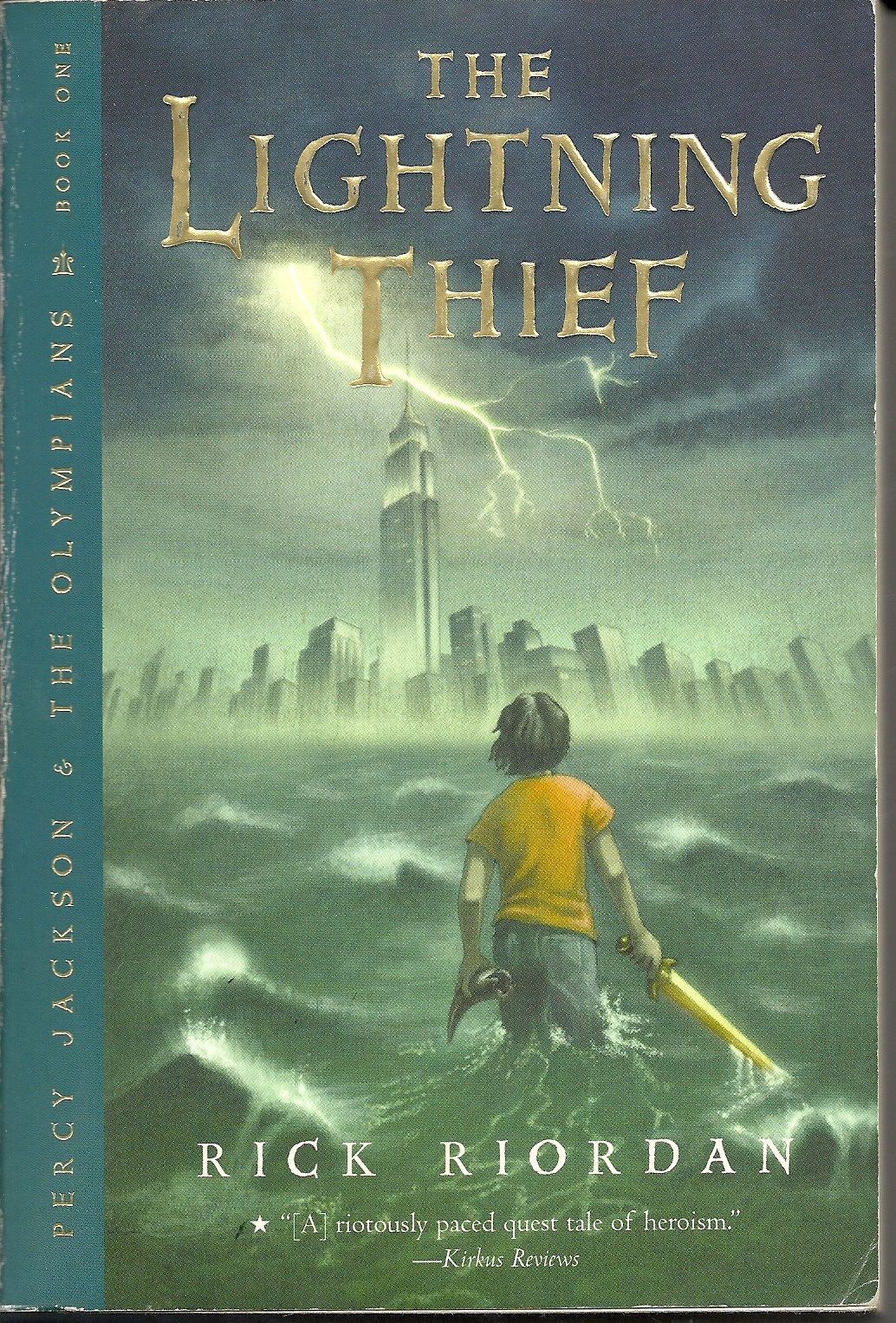
The Lightning Thief
Summary: The Lightning Thief is the first book of the Percy Jackson & Olympians fantasy series. The book features a young boy named Percy Jackson who is a son of the Greek gods. As the son of Poseidon, Percy is a powerful character. After being expelled, he is sent away to Camp Half Blood, which begins to reveal more information about him. Percy is summoned to go on a mission in the Underworld in order to prevent a war among the gods in Olympus. Within this battle, Percy must come to terms with having once been abandoned by his father.
Bib Info: Riordan, R. (2005). The lightning thief. New York, NY: Miramax Books/Hyperion Paperbacks for Children.
Interest Level: 5-8
Impression:Percy is a boy on a fantasy mission that will keep students and an adult wanting to find out what happens next. Percy’s character is a strong-willed and caring individual. I think that this first book is the perfect hook to engage readers in a series.
Reviews and Awards: ALA Notable Children's Books 2006, Library Media Connection 10/01/10, Book Links 07/01/08, New York Times 11/13/05, Booklist 09/15/05, Publishers Weekly 07/18/05, Booklist starred 05/15/09, School Library Journal 06/01/09, Bulletin of the Center for Children's Books 10/01/05, School Library Journal starred 08/01/05, Horn Book 07/01/05, Teacher Librarian 10/01/10, Horn Book starred 04/01/06, Voice of Youth Advocates (VOYA) 08/01/05, Kirkus Reviews 04/15/10, Voice of Youth Advocates (VOYA) starred 06/01/09, Kirkus Reviews starred 06/15/05, Wilson's Junior High School 08/21/06
Reviews: Gr 5-9-An adventure-quest with a hip edge. At first glance, Perseus Jackson seems like a loser (readers meet him at a boarding school for troubled youth), but he's really the son of Poseidon and a mortal woman. As he discovers his heritage, he also loses that mother and falls into mortal danger. The gods (still very active in the 21st-century world) are about to go to war over a lost thunderbolt, so Percy and sidekicks Grover (a young satyr) and Annabeth (daughter of Athena) set out to retrieve it. Many close calls and monster-attacks later, they enter Hades's realm (via L.A.). A virtuoso description of the Underworld is matched by a later account of Olympus (hovering 600 floors above Manhattan). There's lots of zippy review of Greek myth and legend, and characters like Medusa, Procrustes, Charon, and the Eumenides get updates. Some of the Labors of Heracles or Odysseus's adventures are recycled, but nothing seems stale, and the breakneck pace keeps the action from being too predictable. Percy is an ADHD, wise-cracking, first-person narrator. Naturally, his real quest is for his own identity. Along the way, such topics as family, trust, war, the environment, dreams, and perceptions are raised. There is subtle social critique for sophisticated readers who can see it. Although the novel ends with a satisfying conclusion (and at least one surprise), it is clear that the story isn't over. The 12-year-old has matured and is ready for another quest, and the villain is at large. Readers will be eager to follow the young protagonist's next move.
Lothrop, P. (2005, August 1). [Review of the book The lightning thief by R. Riordan]. School Library Journal. Retrieved from: http://www.slj.com/
What if the old Greek myths were true and not just ancient stories? That is the premise of Rick Riordan's new fantasy, adventure book. Percy, who just found out that he is a "Half- Blood," escapes the wrath of a monster when entering summer camp on Long Island. Only, this is no ordinary summer camp. This is a refuge for all children with a mortal parent and one parent that is a demigod. He discovers that his best friend, Grover, from school is a satyr whose job is to protect Percy from monsters and demons. Together with a new friend, who happens to be the daughter of Athena, Percy and Grover must travel across the United States to locate the thief of Zeus' lightning bolt. Because if Zeus doesn't recover his bolt, there will certainly be war between the gods. Students will enjoy the word sparing between Percy and many gods from Greek mythology, who in this book have managed to keep up with the times in language, dress, and attitude. This is a good read that just might have students looking at Greek mythology with a different perspective.
Lymer, D. (2005, August/September). [Review of the book The lightning thief by R. Riordan]. Library Media Connection. Retrieved from: http://www.librarymediaconnection.com/
Use in library setting: Students can learn about the Greek gods through a research project that leads to storytelling. The students can then get into character and share a story with the class based on the Greek god they researched.
Bib Info: Riordan, R. (2005). The lightning thief. New York, NY: Miramax Books/Hyperion Paperbacks for Children.
Interest Level: 5-8
Impression:Percy is a boy on a fantasy mission that will keep students and an adult wanting to find out what happens next. Percy’s character is a strong-willed and caring individual. I think that this first book is the perfect hook to engage readers in a series.
Reviews and Awards: ALA Notable Children's Books 2006, Library Media Connection 10/01/10, Book Links 07/01/08, New York Times 11/13/05, Booklist 09/15/05, Publishers Weekly 07/18/05, Booklist starred 05/15/09, School Library Journal 06/01/09, Bulletin of the Center for Children's Books 10/01/05, School Library Journal starred 08/01/05, Horn Book 07/01/05, Teacher Librarian 10/01/10, Horn Book starred 04/01/06, Voice of Youth Advocates (VOYA) 08/01/05, Kirkus Reviews 04/15/10, Voice of Youth Advocates (VOYA) starred 06/01/09, Kirkus Reviews starred 06/15/05, Wilson's Junior High School 08/21/06
Reviews: Gr 5-9-An adventure-quest with a hip edge. At first glance, Perseus Jackson seems like a loser (readers meet him at a boarding school for troubled youth), but he's really the son of Poseidon and a mortal woman. As he discovers his heritage, he also loses that mother and falls into mortal danger. The gods (still very active in the 21st-century world) are about to go to war over a lost thunderbolt, so Percy and sidekicks Grover (a young satyr) and Annabeth (daughter of Athena) set out to retrieve it. Many close calls and monster-attacks later, they enter Hades's realm (via L.A.). A virtuoso description of the Underworld is matched by a later account of Olympus (hovering 600 floors above Manhattan). There's lots of zippy review of Greek myth and legend, and characters like Medusa, Procrustes, Charon, and the Eumenides get updates. Some of the Labors of Heracles or Odysseus's adventures are recycled, but nothing seems stale, and the breakneck pace keeps the action from being too predictable. Percy is an ADHD, wise-cracking, first-person narrator. Naturally, his real quest is for his own identity. Along the way, such topics as family, trust, war, the environment, dreams, and perceptions are raised. There is subtle social critique for sophisticated readers who can see it. Although the novel ends with a satisfying conclusion (and at least one surprise), it is clear that the story isn't over. The 12-year-old has matured and is ready for another quest, and the villain is at large. Readers will be eager to follow the young protagonist's next move.
Lothrop, P. (2005, August 1). [Review of the book The lightning thief by R. Riordan]. School Library Journal. Retrieved from: http://www.slj.com/
What if the old Greek myths were true and not just ancient stories? That is the premise of Rick Riordan's new fantasy, adventure book. Percy, who just found out that he is a "Half- Blood," escapes the wrath of a monster when entering summer camp on Long Island. Only, this is no ordinary summer camp. This is a refuge for all children with a mortal parent and one parent that is a demigod. He discovers that his best friend, Grover, from school is a satyr whose job is to protect Percy from monsters and demons. Together with a new friend, who happens to be the daughter of Athena, Percy and Grover must travel across the United States to locate the thief of Zeus' lightning bolt. Because if Zeus doesn't recover his bolt, there will certainly be war between the gods. Students will enjoy the word sparing between Percy and many gods from Greek mythology, who in this book have managed to keep up with the times in language, dress, and attitude. This is a good read that just might have students looking at Greek mythology with a different perspective.
Lymer, D. (2005, August/September). [Review of the book The lightning thief by R. Riordan]. Library Media Connection. Retrieved from: http://www.librarymediaconnection.com/
Use in library setting: Students can learn about the Greek gods through a research project that leads to storytelling. The students can then get into character and share a story with the class based on the Greek god they researched.
Wednesday, August 8, 2012
Because of Winn-Dixie
Summary: In this novel, a girl named Opal faced several problems within the story. Her mother left her father when she was three which caused her father, a preacher, to move them to a trailer park in Florida. Her mother was an alcoholic. She misses her mother and does not have a strong relationship with her father. She does not have any friends, which changes after her dad allows her to adopt a stray dog. She does not have a strong relationship with her father, but she and her father grow closer as the story progresses. In result of Winn-Dixie entering her life, Opal’s compassion for others shines through in the end of the story as those around her come together.
Bib Info: DiCamillo, Kate. (2000). Because of Winn-Dixie. Somerville, MA: Candlewick Press.
Interest Level: 3-6
Impression: In this realistic fiction story, the gathering at the end wasn’t realistic in that everyone invited to the party were her friends like the librarian and Otis who was once in jail and Gloria (the woman people called the witch lady). It was realistic in the sense that some students may adopt a stray dog, lives in a single parent household, or may struggle with friends. These are things that a student might be able to identify with.
Reviews and Awards: ALA Notable Children's Books 2001, Newbery Honor 2001, Book Links 03/01/07, Publishers Weekly starred 02/21/00, Booklist 03/15/01, School Library Journal starred 06/01/00, Choice 01/01/01, Wilson's Children 10/01/10, Kirkus Reviews starred 04/01/00, Wilson's Junior High School 01/09/10, New York Times 05/14/00
Reviews: The quick beginning, an essential feature of well-written children's books, carries Because of Winn-Dixie forward quite effectively. The stage is set in the first sentence: "My name is India Opal Buloni, and last summer my daddy, the preacher, sent me to the store for a box of macaroni-and-cheese, some white rice, and two tomatoes, and I came back with a dog." Ten-year-old Opal then proceeds to tell the funny story of a stray dog found in the produce department of the Winn-Dixie grocery store, where she calls him as if he were her own in order to save him from the pound. Because of Winn-Dixie is indeed a dog story, but it is also the story of a child, lonely yet resourceful, who has just recently moved to Naomi, Florida, with her father. It is the story of a motherless child, who longs for the love and comfort that a mother could provide. It is the story of a character finding her way in the world, a character seemingly tentative, yet as starkly defined as her red hair and the big, ugly, smiling stray dog she takes home, washes, and makes her own. And it is the story of Opal's developing friendships with distinctive, well-drawn characters—old Gloria Dump, who is almost blind; the librarian, Miss Franny Block; shy Otis at the pet store—encounters made possible, one way or another, because of the dog, Winn-Dixie. In twenty-six short chapters, DiCamillo has crafted a fine, economical story told in the authentic voice of a child, using regional language and vivid description in a clear, straightforward way. There is immediacy of feeling in this book, perfectly expressing the secret inner life that every child knows. Because of her resourcefulness, demonstrated in the openingchapter and throughout the book at every turn, Opal develops and grows as a character, in both her inner and her outer life. All of this is accomplished through a story worth telling. Children will enjoy Opal's abiding humor and Winn-Dixie's disarming and endearing ways, and the funny and important things that happen when the two of them get together. 2000, Candlewick, $15.99. Ages 9 to 12.
Cerra, K.K. [Review of the book Because of Winn-Dixie by K. Dicamillo]. (2000, November/December). The Five Owls, 15, 2. Retrieved from: http://www.barnesandnoble.com/
Imagine naming a dog "Winn-Dixie" after the grocery store. Your own name causes kids to mock you "Lunch Meat!" That partly describes India Opal Buloni, a preacher's daughter, who tells us about her first summer in Naomi, Florida. Opal adopts the lovable, mangy dog whose personality changes her life and the lives of the quirky characters in this rural community. The kids think Gloria Dump is a witch but Opal discovers a kind, wrinkled old lady with bad eyesight who wins her friendship when she says, "Since I don't see so well, why don't you tell me everything about yourself so I can see you with my heart." Opal couldn't be happier. "I'd been waiting for a long time to tell some person everything about me, I did." A splendid story with heart, humor and hope. This is Newbery quality. Lieberman, J. [Review of the book Because of Winn-Dixie, by K. DiCamillo]. (n.d.). Children’s Literature. Retrieved from: http://www.childrenslit.com/
Use in library setting: The librarian in the book mistakes Winn-Dixie for a bear instead of a dog. Students can write about what kind of animal the librarian mistook Winn-Dixie for. Afterward, the students can compare and contrast the two animals. The students can then share their ideas in a whole group or small group.
Bib Info: DiCamillo, Kate. (2000). Because of Winn-Dixie. Somerville, MA: Candlewick Press.
Interest Level: 3-6
Impression: In this realistic fiction story, the gathering at the end wasn’t realistic in that everyone invited to the party were her friends like the librarian and Otis who was once in jail and Gloria (the woman people called the witch lady). It was realistic in the sense that some students may adopt a stray dog, lives in a single parent household, or may struggle with friends. These are things that a student might be able to identify with.
Reviews and Awards: ALA Notable Children's Books 2001, Newbery Honor 2001, Book Links 03/01/07, Publishers Weekly starred 02/21/00, Booklist 03/15/01, School Library Journal starred 06/01/00, Choice 01/01/01, Wilson's Children 10/01/10, Kirkus Reviews starred 04/01/00, Wilson's Junior High School 01/09/10, New York Times 05/14/00
Reviews: The quick beginning, an essential feature of well-written children's books, carries Because of Winn-Dixie forward quite effectively. The stage is set in the first sentence: "My name is India Opal Buloni, and last summer my daddy, the preacher, sent me to the store for a box of macaroni-and-cheese, some white rice, and two tomatoes, and I came back with a dog." Ten-year-old Opal then proceeds to tell the funny story of a stray dog found in the produce department of the Winn-Dixie grocery store, where she calls him as if he were her own in order to save him from the pound. Because of Winn-Dixie is indeed a dog story, but it is also the story of a child, lonely yet resourceful, who has just recently moved to Naomi, Florida, with her father. It is the story of a motherless child, who longs for the love and comfort that a mother could provide. It is the story of a character finding her way in the world, a character seemingly tentative, yet as starkly defined as her red hair and the big, ugly, smiling stray dog she takes home, washes, and makes her own. And it is the story of Opal's developing friendships with distinctive, well-drawn characters—old Gloria Dump, who is almost blind; the librarian, Miss Franny Block; shy Otis at the pet store—encounters made possible, one way or another, because of the dog, Winn-Dixie. In twenty-six short chapters, DiCamillo has crafted a fine, economical story told in the authentic voice of a child, using regional language and vivid description in a clear, straightforward way. There is immediacy of feeling in this book, perfectly expressing the secret inner life that every child knows. Because of her resourcefulness, demonstrated in the openingchapter and throughout the book at every turn, Opal develops and grows as a character, in both her inner and her outer life. All of this is accomplished through a story worth telling. Children will enjoy Opal's abiding humor and Winn-Dixie's disarming and endearing ways, and the funny and important things that happen when the two of them get together. 2000, Candlewick, $15.99. Ages 9 to 12.
Cerra, K.K. [Review of the book Because of Winn-Dixie by K. Dicamillo]. (2000, November/December). The Five Owls, 15, 2. Retrieved from: http://www.barnesandnoble.com/
Imagine naming a dog "Winn-Dixie" after the grocery store. Your own name causes kids to mock you "Lunch Meat!" That partly describes India Opal Buloni, a preacher's daughter, who tells us about her first summer in Naomi, Florida. Opal adopts the lovable, mangy dog whose personality changes her life and the lives of the quirky characters in this rural community. The kids think Gloria Dump is a witch but Opal discovers a kind, wrinkled old lady with bad eyesight who wins her friendship when she says, "Since I don't see so well, why don't you tell me everything about yourself so I can see you with my heart." Opal couldn't be happier. "I'd been waiting for a long time to tell some person everything about me, I did." A splendid story with heart, humor and hope. This is Newbery quality. Lieberman, J. [Review of the book Because of Winn-Dixie, by K. DiCamillo]. (n.d.). Children’s Literature. Retrieved from: http://www.childrenslit.com/
Use in library setting: The librarian in the book mistakes Winn-Dixie for a bear instead of a dog. Students can write about what kind of animal the librarian mistook Winn-Dixie for. Afterward, the students can compare and contrast the two animals. The students can then share their ideas in a whole group or small group.
Subscribe to:
Posts (Atom)